Wednesday, November 10, 2010

Dekka's Artisans Market in Review

While a bit slow at times, Dekka's Artisan's Market was an entertaining way to spend my Sunday afternoon. I met some awesome local artisans including Migdalia and Erika Taguchi-Newton.

Migdalia makes purses out of recycled t-shirts and embellishes them with her unique dolls.


Erika Taguchi-Newton is an illustrator specializing in what she calls "fantasy art and geeky crafts." 


Add caption


Sunday, November 7, 2010

Live Painting Today at Dekka

Dekka, the fashion, art, and music boutique where some of my work is hung, is having their first ever Sunday Artisans Market. Originally planned to be a monthly event, the Dekka owners got such a heavy response that the Artisans Market will be held every Sunday. Today I'll be doing some live painting down at the show. I'll also be tweeting from the event from my new twitter handle, so be sure to follow me at twitter.com/_kaitlincarroll .

Saturday, November 6, 2010

How to Stretch a Canvas

One must have in a painter's arsenal is knowing how to stretch a canvas. So, here goes, some step by step instructions on how to stretch a canvas. Through the photo series, I stretch my own gallery wrapped canvas. Gallery wrapping simply means that the canvas is wrapped all the way around the edges and stapled to the back and the sides are primed just as the surface.  The clean edges allow the finished painting to be hung without a frame, if you so choose.

Materials You'll Need:
Materials
  • Wood ( I use 1 x 3" pine)
  • Canvas
  • Hammer
  • Nails
  • Angle
  • Scissors
  • Plyers
  • Staple Gun
  • Large Paint brush
  • Acrylic Gesso (white or tinted)
Step 1: Align Stretcher Bars


Lay out the wood stretcher bars. Align them, use the angle to make sure they are at 90 degrees.

Step 2: Nail Stretcher Bars


Nail the stretcher bars together at the corners. Use the angle while hammering to ensure the bars are secured at right angle.


Step 3: Layout, Measure, and Cut Canvas

Layout Canvas


To ensure that there is enough canvas to wrap around, measure the depth of the stretcher bars and add 2 to 3" more. The stretcher bars shown are 3" deep, so I've measured 6" around the entire frame. Cut canvas accordingly.

Step 4: Wrapping the Canvas


Starting at the center of one side of the frame, use the plyers to help get a good grip on the canvas (doing this with your hands will lead to raw knuckles, learn from my experience). Pull the canvas firmly with the plyers in one hand and using the staple gun secure the canvas to the frame.

Continue pulling the canvas and stapling, working opposing sides to ensure an evenly stretched canvas. Start at the top center, move to the bottom center, then right side center, and finally left side center. Start again 2 to 3" right of top center and continue as above. Repeat from 2 to 3" left of  top center. Work in this way until all sides of the frame are covered.

Step 5: Corners


Once all the sides are covered, there'll be excess canvas at the corners. As a professor said when teaching me how to stretch a canvas, "If you can make a bed, you can stretch a canvas," at which point I realized that I didn't know how to fold the corners of a mattress. Well, now I do.

Pull the excess canvas into a sharp triangle, make sure there's no slack in the edges of the canvas. Fold the triangle to one side of the stretcher, making a 90 degree angle (as shown in No.2 above). Wrap the excess behind the canvas and staple.

Step 6: Gesso


Use an acrylic gesso to seal the canvas. Paint 2 to 3 coats of gesso on the surface and sides of the canvas. Let the gesso dry between each coat.


Voila!

Friday, November 5, 2010

Artist's Statement: Baby Step No. 2

In continuation of preparing an artist's statement, the next step is writing down a short list of words and phrases you think of when pondering your work. Here's mine:

  • landscape
  • escapism
  • reminiscence
  • loneliness vs. self reliance (in the Emerson-ian sense)
  • affectation
  • atmosphere
  • abstraction
  • sentimentality (with both positive and negative connotations)
  • evocative

Thursday, November 4, 2010

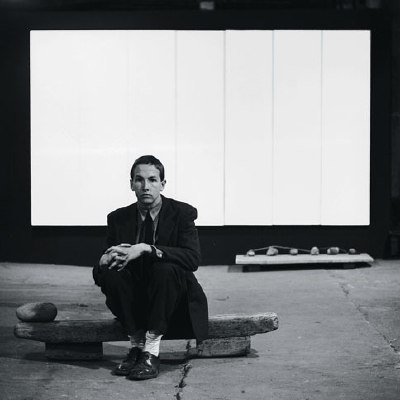
On the Easel: An Experiment Derived from Rauschenberg's White Paintings

No. 43 (36 x 34")


No. 43 Detail
No. 44 (24 x 24")


No. 45 (12 x 12")
This week I've been looking at Robert Rauschenberg's work, namely his white paintings (pictured below). These abstract works are wonderfully perplexing, challenging the viewer's concept of art. The Guggenheim said of these paintings,
 "In the summer of 1951 Robert Rauschenberg created his revolutionary White Paintings at Black Mountain College, near Asheville, North Carolina. At a time when Abstract Expressionism was ascendant in New York, Rauschenberg’s uninflected all-white surfaces eliminated gesture and denied all possibility of narrative or external reference."
For a while I've been working in close values, but thinking about Rauschenberg's work has made me wonder how close can I get my values while still maintaining a landscape? So this week I've been working on pushing the values near the horizon line closer and closer together. No. 43,  a painting for some family friends, is still in progress and unlikely to stay in its current state. However, No. 44, in my opinion, is wonderfully successful in this experiment.

White Painting (several panel), 1951
White Painting, 1951

Wednesday, November 3, 2010

Writing An Artist's Statement in Baby Steps

Graduate programs, internships, and galleries want you to have an artist's statement. I came out of college knowing I needed one, but dreading writing it. One or two paragraphs summing up my work, process, themes, and raison d'etre!? eeek! So rather than face this daunting task outright, I'm going to take baby steps.

A few simple questions:
How did you get into this work?
I've always wanted to be an artist. Well that's not true, first I wanted to be a doctor clown (what can I say, I was a creative kid), then there was a while in my early teens when I wanted to be a musician, but other than that, I've always wanted to be an artist. I'd be doing myself a great disservice if I didn't at least try. 

My current work, the landscapes, came about due to a series of college classes taken in a certain order. I took a landscape drawing class with Sarah Frankel followed the next year by a painting class with C of C's resident abstract expressionist Michael Phillips. So I started playing with abstraction in landscapes. John Hull, the Studio Art department chair, said once that abstraction itself can be the subject matter of a painting, or abstraction can be the mantle through which the subject matter is discussed. I loved this idea, to paint landscapes without out rightly painting a landscape, to let the landscape be the mantle through which I discuss my themes.


How do you feel when your work is going well?
 Exuberant, like walking out into the sun, like the world makes sense for a few hours.


What are some of your favorite things about your work?
The atmospheric quality. The tactility of the wood. The emotionally evocative quality.

Here are a few helpful resources I've gathered from the internet.

Tuesday, November 2, 2010

New Portfolio Website


For the last year my brother has been very gracious in hosting my website on his web server. About two months ago, he decided to trim this toy from his budget and I took it upon myself to not only get my own web hosting, but to rebuild my website, by hand, from scratch, all by myself (well, almost). Two months, a trip to the local library later, and some whining at my brother, here is the outcome, my new portfolio site (warning: it looks crappy in Internet Explorer, I'm not that good).

This of course has led to a redesign and rethinking of my blog. To bring more viewers to my work I'll be writing new article segments, including:
  • Artist's I'm Looking At
  • How To
  • Notable Etsians and Bloggers in the Arts
  • Graduate School Admissions Process
  • En Plien Aire Painting
  • Small Business Articles
I'd like to include a monthly contest (which totally wouldn't be a rip off Cate Wade's Sepia Sunday Photo Contest, not at all), though I haven't come up with the exact criteria.